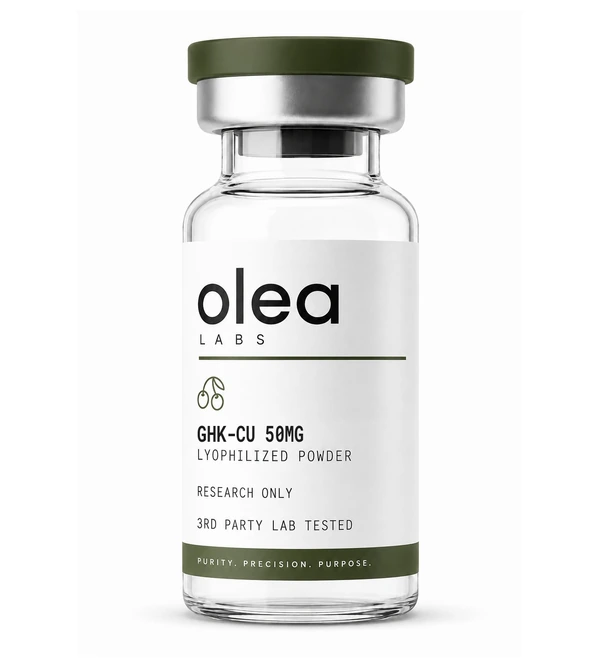
Isolated from human plasma in 1973, GHK-Cu has five decades of published skin and wound-healing research. The mechanism, the gene-expression data, and how to verify a batch.
In 1973, biochemist Loren Pickart isolated a small tripeptide from human plasma that appeared to make old liver cells synthesize proteins like young ones. That peptide — glycyl-L-histidyl-L-lysine, bound to copper — became GHK-Cu, now one of the most extensively documented cosmetic and wound-research peptides in existence, with a literature spanning five decades.
A peptide that declines with age
GHK circulates naturally in human plasma at roughly 200 ng/mL at age 20, declining to about 80 ng/mL by age 60. That age-related decline, documented by Pickart's group, is the observation around which most GHK-Cu research is framed: if a naturally occurring repair signal fades with age, what does restoring it do in experimental systems?
The copper is not decoration
GHK coordinates a divalent copper ion through the histidine imidazole nitrogen, the glycine amino group, and a deprotonated peptide nitrogen, forming a square-planar complex. Copper is a required cofactor for lysyl oxidase — the enzyme that cross-links collagen and elastin — and for superoxide dismutase, a frontline antioxidant enzyme. The complex is effectively a delivery system placing bioavailable copper at sites of tissue remodeling, which is why the deep-blue color of a properly formed GHK-Cu solution is a meaningful quality indicator, not an aesthetic one.
The gene-expression findings
The Broad Institute's Connectivity Map — a database cataloging how compounds alter gene expression — contains some of the most-cited GHK data. Published analyses report that GHK modulates the expression of a substantial number of human genes, with upregulation of genes involved in tissue repair and antioxidant defense, and downregulation of genes associated with inflammatory signaling. These are in vitro expression findings, not clinical outcomes, but they explain the breadth of experimental interest.
Documented research endpoints
- Collagen I/III and elastin transcript upregulation in cultured fibroblasts
- Increased decorin expression, relevant to collagen-fibril organization
- Modulation of metalloproteinase (MMP) and TIMP balance in matrix-remodeling models
- Stimulation of angiogenic markers in wound-model literature
- Antioxidant enzyme expression changes, including SOD pathways
Verifying a GHK-Cu batch
| Test | Expected Result |
|---|---|
| HPLC | ≥98% purity of the GHK peptide |
| LC-MS | GHK mass confirmed at 340.4 Da |
| Copper content | ~17–20% by mass for the 1:1 complex |
| UV-Vis | Absorbance maximum near 620 nm |
| Appearance | Blue to blue-green lyophilized powder |
A white or colorless 'GHK-Cu' sample fails the most basic identity check — the copper complex is blue by definition. This makes GHK-Cu one of the few peptides with a meaningful visual first-pass verification.
Are 'copper peptide' and GHK-Cu the same thing?
In research contexts, yes — both terms refer to the copper(II) complex of the GHK tripeptide.
Why is GHK-Cu blue?
The Cu²⁺ ion coordinated by GHK absorbs visible light around 620 nm. The blue color is direct evidence the complex has formed correctly.
Is GHK-Cu the same as injectable GHK?
The peptide-copper complex is chemically identical; research material is characterized the same way regardless of the model it is intended for.