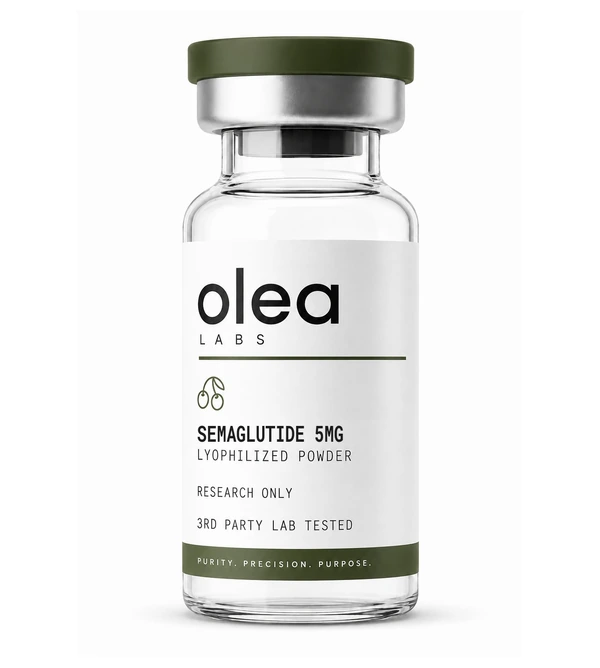
The research reference for semaglutide — the GLP-1 mono-agonist whose STEP and SELECT trial programs defined the modern incretin era.
Before semaglutide, GLP-1 agonists were a diabetes footnote. After the STEP trials, they became the most-studied drug class in metabolic research. Semaglutide remains the reference standard of the class — the compound every newer incretin is benchmarked against — and one of the most analytically characterized peptides a US laboratory can source.
How the molecule was engineered
Native GLP-1 survives in circulation for about two minutes before DPP-4 cleaves it. Semaglutide solves this with two substitutions: an aminoisobutyric acid at position 8 that sterically blocks DPP-4, and a C18 fatty diacid chain attached at lysine 26 through a glutamic acid spacer. The fatty acid binds albumin, producing a circulating half-life of approximately seven days — a 5,000-fold extension over the native hormone.
Mechanism in one paragraph
Semaglutide selectively activates the GLP-1 receptor, a class B GPCR expressed in pancreatic beta cells, the gastrointestinal tract, and appetite-regulating circuits of the hypothalamus and brainstem. Downstream cAMP signaling enhances glucose-dependent insulin secretion, suppresses inappropriate glucagon release, slows gastric emptying, and reduces caloric intake through central satiety pathways — the four mechanisms that combine to produce its published glycemic and weight outcomes.
The landmark data
| Trial | Design | Key Result |
|---|---|---|
| STEP 1 | 1,961 adults with obesity, 68 weeks | ~14.9% mean weight loss vs. 2.4% placebo |
| SUSTAIN-6 | T2D cardiovascular outcomes | Significant MACE risk reduction |
| SELECT | 17,604 adults, overweight + CVD | 20% reduction in major cardiovascular events |
SELECT mattered beyond weight: it demonstrated that semaglutide reduced heart attacks, strokes, and cardiovascular death in people with established cardiovascular disease but without diabetes — repositioning the entire drug class from metabolic to cardiometabolic.
Verification standards for research batches
- HPLC purity ≥98% with chromatogram on file
- LC-MS confirming average mass near 4,113.6 Da — this also proves the C18 side chain is present
- Counterion identity and content quantified
- Endotoxin screening where downstream cell-culture work is planned
- Batch number on the vial matching the COA exactly
What is the difference between semaglutide and tirzepatide?
Semaglutide is a GLP-1 mono-agonist; tirzepatide adds GIP receptor agonism. Published head-to-head data shows tirzepatide producing greater mean weight loss at their respective top studied doses.
Why does semaglutide last a week when native GLP-1 lasts minutes?
Two modifications: Aib at position 8 blocks DPP-4 cleavage, and a C18 fatty diacid chain binds albumin, slowing renal clearance.