Two mutations turned a two-hour growth factor into a day-long one. How IGF-1 LR3 works, why cell-culture media uses it, and how to verify a recombinant batch.
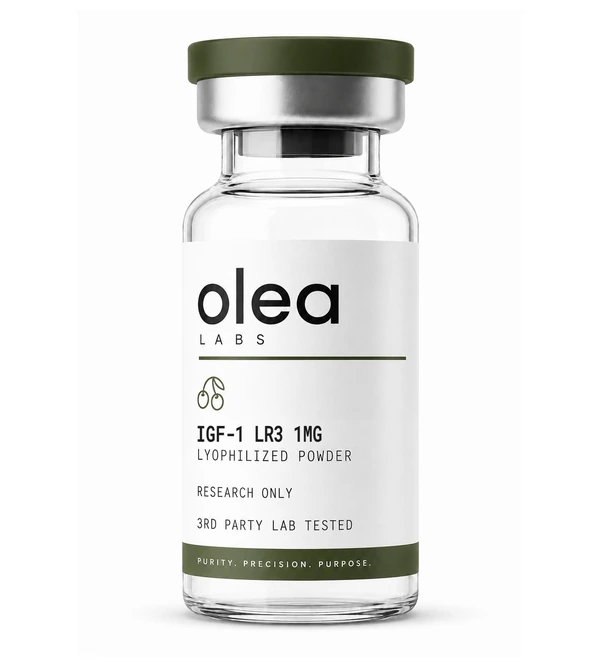
Native IGF-1 is a 70-amino-acid growth factor with a problem: in circulation, over 95% of it is bound and inactivated by IGF binding proteins, and the free fraction clears in minutes to hours. IGF-1 LR3 is the engineered answer — the most widely used long-acting IGF-1 analog in cell-culture and muscle-biology research.
Two changes, one hundred-fold difference
LR3 combines an arginine substitution at position 3 (the 'R3') with a 13-amino-acid N-terminal extension peptide (the 'L'). Together these changes reduce affinity for IGF binding proteins by roughly two orders of magnitude. The result: instead of being sequestered and cleared, the analog remains free to engage the IGF-1 receptor, with an effective bioactive half-life measured in many hours rather than minutes.
The receptor biology
IGF-1 receptor activation drives two canonical signaling cascades: PI3K/Akt (protein synthesis, cell survival, glucose uptake) and Ras/MAPK (proliferation). In muscle-cell culture, IGF-1 LR3 is used to study myoblast proliferation and differentiation and hypertrophy signaling. In industrial cell culture, it is a standard media supplement for improving recombinant-protein yields in mammalian cell lines — arguably its largest legitimate application by volume.
Recombinant production and what it means for verification
At 83 amino acids, IGF-1 LR3 is produced by recombinant expression in E. coli rather than solid-phase synthesis, followed by oxidative refolding to form its three disulfide bonds. This changes the analytical picture: verification must confirm not just mass but correct disulfide connectivity and the absence of misfolded aggregates, which is why reputable suppliers pair HPLC with LC-MS and report aggregation state.
| Property | Native IGF-1 | IGF-1 LR3 |
|---|---|---|
| Length | 70 aa | 83 aa |
| Binding-protein affinity | High | ~100x lower |
| Effective half-life | Minutes–hours (free fraction) | Many hours |
| Approx. mass | 7,649 Da | 9,111 Da |
Verification standards
- RP-HPLC purity ≥98%
- LC-MS confirming the ~9,111 Da mass
- Endotoxin testing — essential given E. coli expression
- Documented refolding/aggregation status