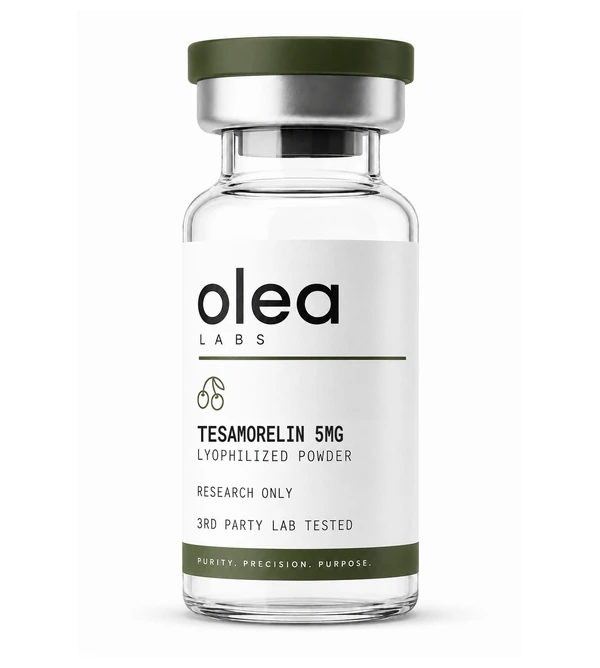
Tesamorelin is the only GHRH analog with FDA approval — and its visceral adipose tissue data gave growth-hormone-axis research a rare, validated clinical endpoint.
Most growth-hormone-releasing peptides live entirely in the research world. Tesamorelin crossed over: it is an FDA-approved pharmaceutical (for reduction of excess abdominal fat in HIV-associated lipodystrophy), which makes its published dataset unusually rigorous for the GHRH class — and makes it a valuable reference compound for laboratories studying the GH/IGF-1 axis.
Structure and mechanism
Tesamorelin is the full 44-amino-acid human GHRH sequence with a trans-3-hexenoyl group attached to the N-terminal tyrosine. The modification protects against DPP-4 cleavage while preserving receptor potency, extending the half-life enough for once-daily administration in published protocols. It stimulates the pituitary's own somatotrophs, so GH release remains subject to endogenous feedback — a mechanistic distinction from exogenous GH that matters in study interpretation.
The visceral-fat data
The pivotal Phase 3 trials measured visceral adipose tissue (VAT) directly by CT scan — an unusually hard endpoint for the field. Over 26 weeks, tesamorelin groups showed mean VAT reductions of roughly 15–18% versus small increases on placebo, with corresponding IGF-1 elevations confirming axis engagement. Triglyceride improvements accompanied the imaging findings. Equally instructive: VAT returned toward baseline within months of discontinuation, cleanly demonstrating that the effect requires continued axis stimulation.
Why it remains a research reference standard
- Full-length GHRH pharmacology with human pharmacokinetic characterization
- Objective imaging endpoints (CT-quantified VAT) in controlled trials
- Defined IGF-1 dose-response relationship useful for assay calibration
- Approved-drug analytical standards meaning synthesis and impurity profiles are exceptionally well documented
Verification standards for research material
- HPLC purity ≥98%
- LC-MS confirmation of the 5,135.9 Da average mass, including the hexenoyl modification
- Counterion quantification
- Endotoxin testing for cell-culture applications